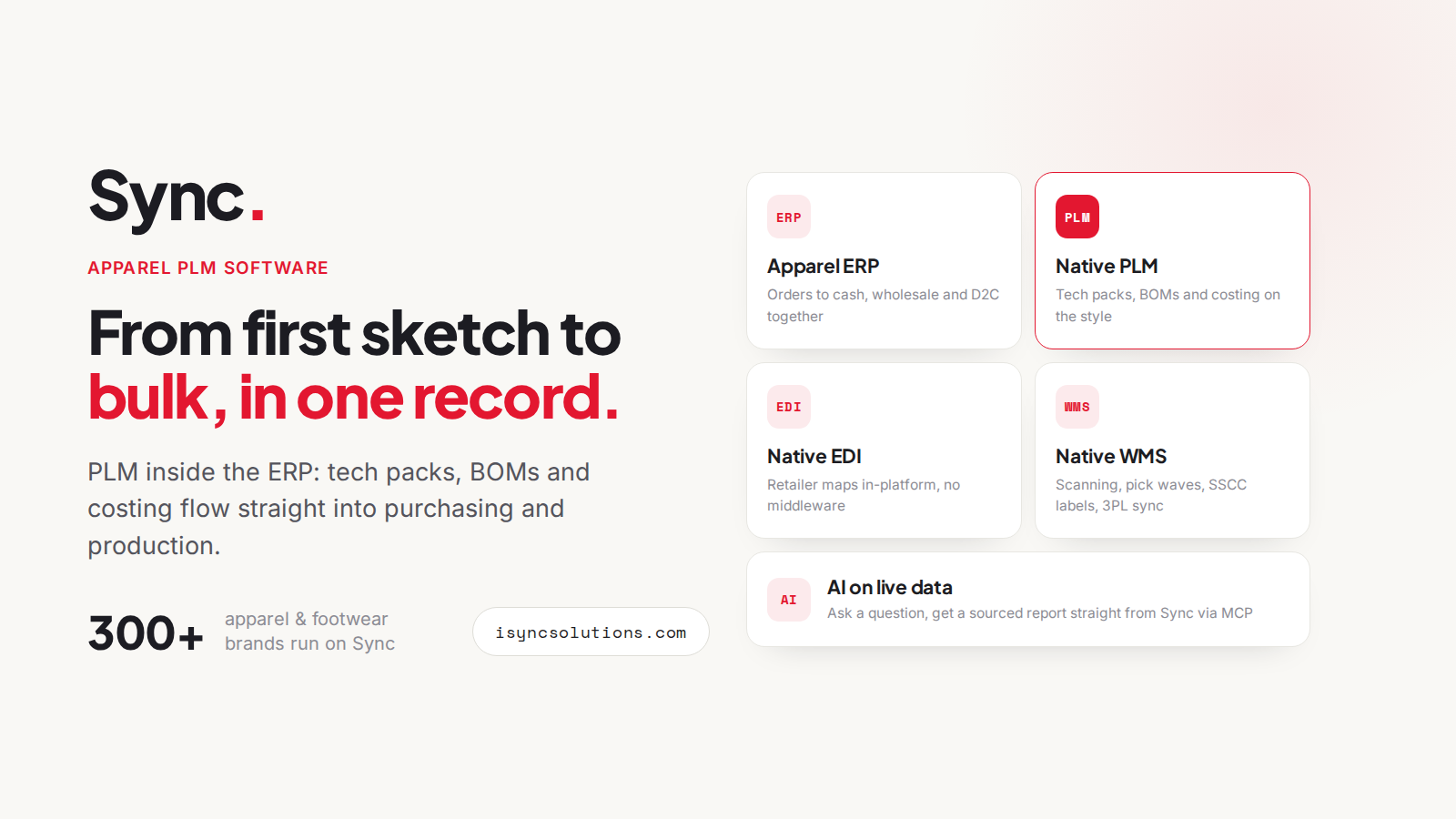
Sync PLM manages apparel product development end to end – style master, bill of materials, range and line planning, size matrix, critical path, tech packs, specifications, quality audits and fabric and trim libraries. And because it sits inside the Sync ERP, an approved style becomes a costed, purchasable, sellable product without a handover.
Most apparel development still runs on spreadsheets, PDF tech packs and email. The moment a fabric is swapped, a measurement is graded differently or a trim is discontinued, the version in the factory’s inbox stops matching the version in the designer’s folder. Nobody finds out until a sample arrives wrong or a costing is rebuilt from scratch.
PLM fixes that by making the style itself the source of truth. Colorways, size ranges, components, measurements, artwork, suppliers, sample rounds, approvals and dates all hang off one record. Change something once and every place it appears reflects it – including the tech pack the factory is looking at.
Sync goes one step further: the same record that development works on is the one production, purchasing, wholesale and finance work on. There is no export, no integration and no second style master to maintain.
Everything a development, technical design and sourcing team needs – without stitching tools together.
One record per style carrying colorways, size range, category, season, seasonality, status, revisions and every linked component.
02Every fabric, trim, label and packaging item with consumption, placement, supplier and cost – costed as the style develops.
03Build the season by category, price point, delivery and option count – and see the plan against what development is actually delivering.
04Define which size and color combinations exist, per market and per channel, and carry that matrix through to buying and selling.
05Milestone dates per style and season with owners, dependencies and exception flags, so late work surfaces before delivery is at risk.
06Generated live from the style record – construction, BOM, measurements, artwork, labelling and packing, always current for the factory.
07Points of measure, grading rules, tolerances and sample measurement results captured round by round against the spec.
08Inline and final audits with defect classification, AQL results, photo evidence and pass or fail decisions held against the style.
09Reusable components with supplier, composition, width, price and lead time. Update once and every style using it updates.
The record everything else attaches to. Season, category, silhouette, fit block, colorways, size range, target price, status and revision history – held once and referenced everywhere.
| Rev | Change | Owner | Date |
|---|---|---|---|
| 3 | Main body fabric changed to CT-2210 | K. Ross | 12 Mar |
| 2 | Chest pocket added, spec updated | M. Ellis | 04 Mar |
| 2 | Colorway “Brick” added | K. Ross | 28 Feb |
| 1 | Size range extended to XXL | A. Devi | 19 Feb |
| 1 | Style created from FW25 block | M. Ellis | 11 Feb |
Every component on the garment – fabric, thread, interlining, zips, buttons, labels, hangtags, polybag, carton – with consumption, placement, supplier and cost. The costed BOM builds itself as the style develops.
| Component | Supplier | Cons. | Cost |
|---|---|---|---|
| CT-2210 Cotton twill | Nantong Mills | 1.85 m | 7.96 |
| LN-118 Pocket bag | Nantong Mills | 0.22 m | 0.61 |
| BT-05 Corozo button | Trimco | 9 pc | 1.08 |
| TH-40 Core thread | Trimco | 180 m | 0.34 |
| LB-02 Main label set | Avery | 1 set | 0.42 |
| PK-11 Polybag & carton | Pack Co | 1 set | 0.29 |
Plan the season before the styles exist. Set option counts, price architecture, category splits and delivery drops – then watch the plan fill up with real styles as development progresses.
| Category | Planned | Adopted | Avg FOB |
|---|---|---|---|
| Woven tops | 22 | 19 | $17.90 |
| Knit tops | 30 | 31 | $9.20 |
| Bottoms | 18 | 12 | $21.40 |
| Outerwear | 10 | 8 | $34.60 |
| Accessories | 14 | 14 | $4.75 |
Apparel is a matrix, not a SKU. Define exactly which size and color combinations exist – including combinations that only run in certain markets, channels or deliveries – and carry that structure through the whole platform.
| COLORWAY | XS | S | M | L | XL | XXL |
|---|---|---|---|---|---|---|
| Washed Black | ✓ | ✓ | ✓ | ✓ | ✓ | ✓ |
| Dune | — | ✓ | ✓ | ✓ | ✓ | ✓ |
| Deep Sea | ✓ | ✓ | ✓ | ✓ | ✓ | — |
| Brick | — | ✓ | ✓ | ✓ | ✓ | — |
The season calendar, per style. Design freeze, BOM sign-off, proto, fit, PP sample, bulk fabric commitment, ex-factory, delivery – each with an owner, a due date and a dependency on the step before it.
Stop emailing PDFs and spreadsheets. The tech pack is a live view of the style record – so the factory is always looking at the current revision, not the one they downloaded three weeks ago.
Points of measure, grade rules and tolerances held per fit block and per style. Sample measurements are recorded round by round against the spec, so fit decisions are based on data instead of memory.
| POINT OF MEASURE | S | M | L | XL |
|---|---|---|---|---|
| Chest 1” below armhole | 21 1/2 | 22 1/2 | 23 1/2 | 24 1/2 |
| Body length from HPS | 28 3/8 | 29 1/8 | 29 7/8 | 30 5/8 |
| Across shoulder | 17 3/4 | 18 5/8 | 18 3/4 | 19 1/4 |
| Sleeve length from CB | 33 3/4 | 34 1/2 | 35 1/4 | 36 3/4 |
| Cuff opening | 9 1/8 | 9 3/8 | 9 5/8 | 9 7/8 |
Inline and final inspections recorded against the style and the purchase order – with defect classification, sampling results, photo evidence and a documented pass or fail decision.
Stop rebuilding the same components every season. Fabrics, trims, labels, packaging, colors and measurement sets live in shared libraries with supplier, composition, width, price, lead time and certification data attached.
Most brands end up owning both. The difference is whether there is a seam between them.
Colorways, size matrix and BOM are approved on the style record.
The same record is the product wholesale and B2B sell against – no export.
BOM consumption becomes raw material requirements and supplier POs.
Goods receipt, inventory, EDI, invoicing and landed cost all reference the same style.
Some of the best apparel and footwear brands in the world run Sync. They’ve shaped every part of it.
We selected Sync based on their highly efficient, finely tuned system that is apparel industry specific. Sync has provided the platform we required to grow our brands in the global arena.
We are in a 1000% better place now than we were with the old system. Sync has given us access to more data visibility and reporting than ever before.
Sync revolutionized our operations. Transitioning from a manual system was a game-changer… the team at Sync values our brand and treats us like a true partner, not just a paying customer.
Apparel PLM (product lifecycle management) software manages a garment from first concept to production handover. It holds the style master record, the bill of materials, tech packs, specifications and grading, colorways and size ranges, the critical path calendar, supplier and factory collaboration, costing and quality audits – so every team works from one version of the product instead of emailed spreadsheets and PDFs.
PLM covers what the product is – design, specifications, materials, tech packs, samples and approvals. ERP covers what happens to it commercially – purchase orders, inventory, sales orders, shipping and finance. Most brands run them as separate systems and maintain an integration between them. In Sync, PLM and ERP are the same system, so an approved style and its bill of materials become a purchasable, sellable product without a data handover.
Not if the ERP includes PLM natively. The usual reason brands buy a standalone PLM is that their ERP has no concept of tech packs, grading, sample rounds or a critical path. Sync includes those modules in the platform, which removes the integration, the duplicated style master and the reconciliation work between two systems.
Yes. Tech packs are built from the style record, so construction details, the bill of materials, measurement specifications, artwork placement, labelling and packing notes all draw from live data. Change a component in the library and every style using it reflects the change, rather than needing a new PDF to be rebuilt and re-sent.
Yes. Suppliers and factories can be given controlled access to the styles they are working on, so quotes, sample comments, measurement results and approvals stay attached to the correct style and revision instead of sitting in email threads.
The critical path is a milestone calendar per style or per season – design freeze, BOM sign-off, proto, fit sample, PP sample, bulk fabric commitment, ex-factory and delivery. Dates are owned, dependencies roll forward when something moves, and exceptions surface so merchandisers see the styles that are late before the delivery window is at risk.
Yes. Because the bill of materials carries cost data on every component, a costed BOM builds as the style develops. You can compare vendor quotes side by side, cost variants that differ by colorway or trim, and see projected margin against target price before the style is committed to bulk.
Yes. Because PLM and ERP share one data model in Sync, the approved bill of materials drives raw material requirements and supplier purchase orders directly, rather than being re-keyed into a separate system after development finishes.
Independent, editorial guides for teams evaluating apparel PLM. No product pitch - just the mechanics of how PLM works and how brands make it fit.
No generic slides. Bring a real style and we’ll show Sync running your BOM, your tech pack, your critical path – design to delivery.